

Use iPaaS for real-time operational integration between applications; use ETL for scheduled analytical pipelines feeding a warehouse. Most mid-sized and large organisations end up needing both, running side by side rather than competing for the same job. The real question is not which one wins, but which workload you are looking at when you ask.
TL;DR:
- iPaaS is ideal for real-time, event-driven integrations where low latency is critical, such as updating systems immediately after an event occurs.
- ETL or ELT are better suited for processing large volumes of data on a schedule, especially for complex transformations and historical data consolidation.
- Heavy, multi-step transformations across big datasets favor ETL, while iPaaS handles lighter, per-record data manipulation efficiently.
- Combining both tools is common in larger organizations, with iPaaS managing operational app connectivity and ETL feeding analytical systems.
- Proper governance and data residency requirements often influence the choice, as ETL supports hybrid deployments; iPaaS is increasingly offering compliance options.
Table of Contents
- ETL vs iPaaS: what ETL actually does
- What is iPaaS and why does it exist?
- Key differences that decide procurement and architecture
- Choosing between iPaaS, ETL, or both
- Where iPaaS and ETL now overlap
- A short checklist before you sign a contract
- Why mapping accuracy matters more than the tool you choose
- The one mistake that undoes both patterns
- How Inferrex reduces the mapping risk behind both patterns
- Sources
- FAQ
ETL vs iPaaS: what ETL actually does
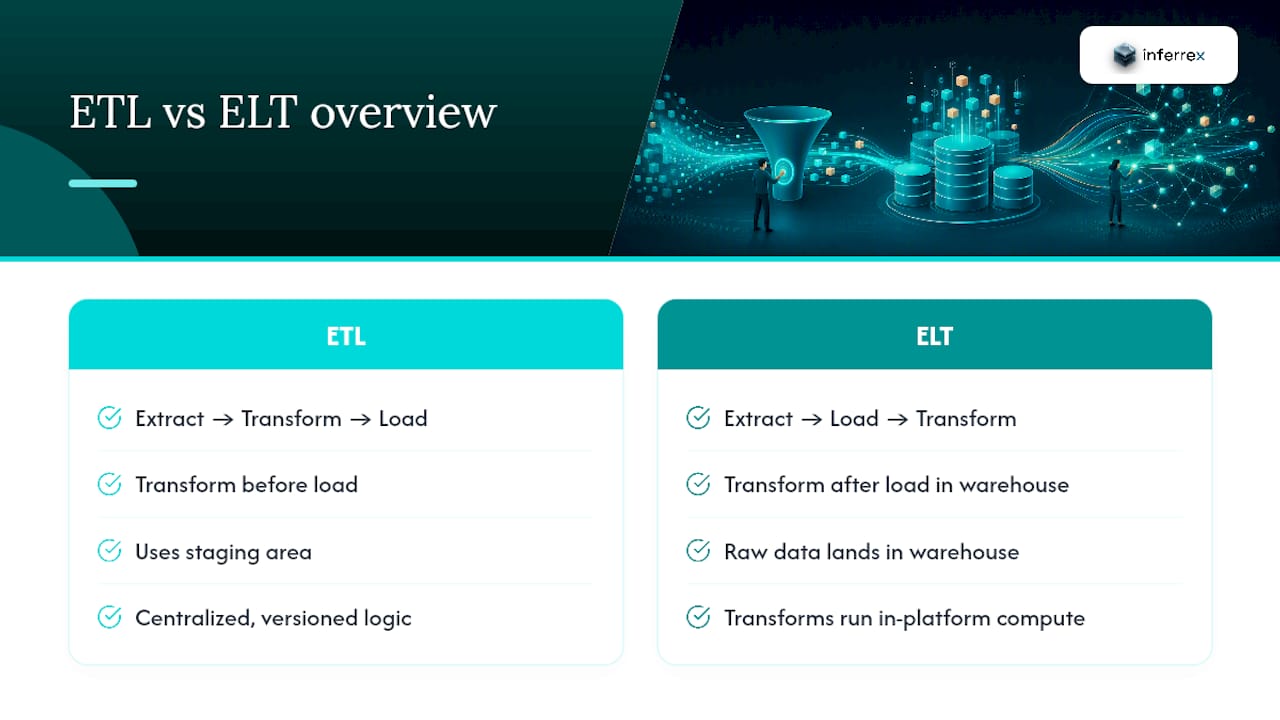
ETL, extract, transform, load, moves data in batches from source systems into a staging area, reshapes it against a target schema, then loads it into a warehouse or lake. The transformation happens before the data lands, which is the whole point: analysts get clean, conformed tables rather than raw exhaust from a dozen different systems. Think of it as a customs house for data. Nothing crosses the border into your warehouse without being declared, checked, and stamped.
This is why ETL remains the backbone for consolidating large volumes into analytical repositories, while iPaaS excels at application connectivity and workflow automation. Governance benefits from that staging step too. Auditors and compliance teams tend to like a clear point where transformation logic lives, versioned and testable, rather than scattered across dozens of point-to-point integrations.
ELT, extract, load, transform, flips the order: raw data lands first, then transformation happens inside the warehouse itself, using the target platform's own compute. This has become the default in cloud data stacks built on Snowflake, BigQuery, or Databricks, because warehouse compute is now cheap and elastic enough to absorb the transformation workload. ELT suits teams with fast-changing reporting needs, where rigid upfront schemas would slow everyone down. ETL still wins when you need transformation logic enforced centrally, before anything touches a shared table, particularly under stricter governance regimes.
What is iPaaS and why does it exist?
iPaaS, integration platform as a service, connects applications directly, usually through prebuilt connectors, webhooks, and API management layers, and moves data the moment an event happens rather than on a schedule. A new lead in your CRM triggers a workflow that updates your billing system within seconds. That is the core promise: iPaaS is built for real-time, event-driven integration between SaaS applications, not for warehousing.
Most iPaaS platforms lean heavily on low-code or no-code interfaces. A business analyst can wire together a Salesforce to Slack notification without writing a line of code, which is a genuine advantage when the integration itself is simple and the bottleneck has traditionally been engineering time. That accessibility is also iPaaS's boundary. Ask it to reshape years of historical transaction data with complex joins and conditional logic, and the same low-code interface that made simple workflows fast starts to strain under complexity it was never designed to carry. iPaaS platforms can batch process, but heavy historical transforms at analytical scale are not their natural habitat, and stretching them there tends to show up first in performance, then in maintenance cost.
Key differences that decide procurement and architecture
The distinction between iPaaS and ETL sits on four axes that matter far more in practice than any feature checklist.
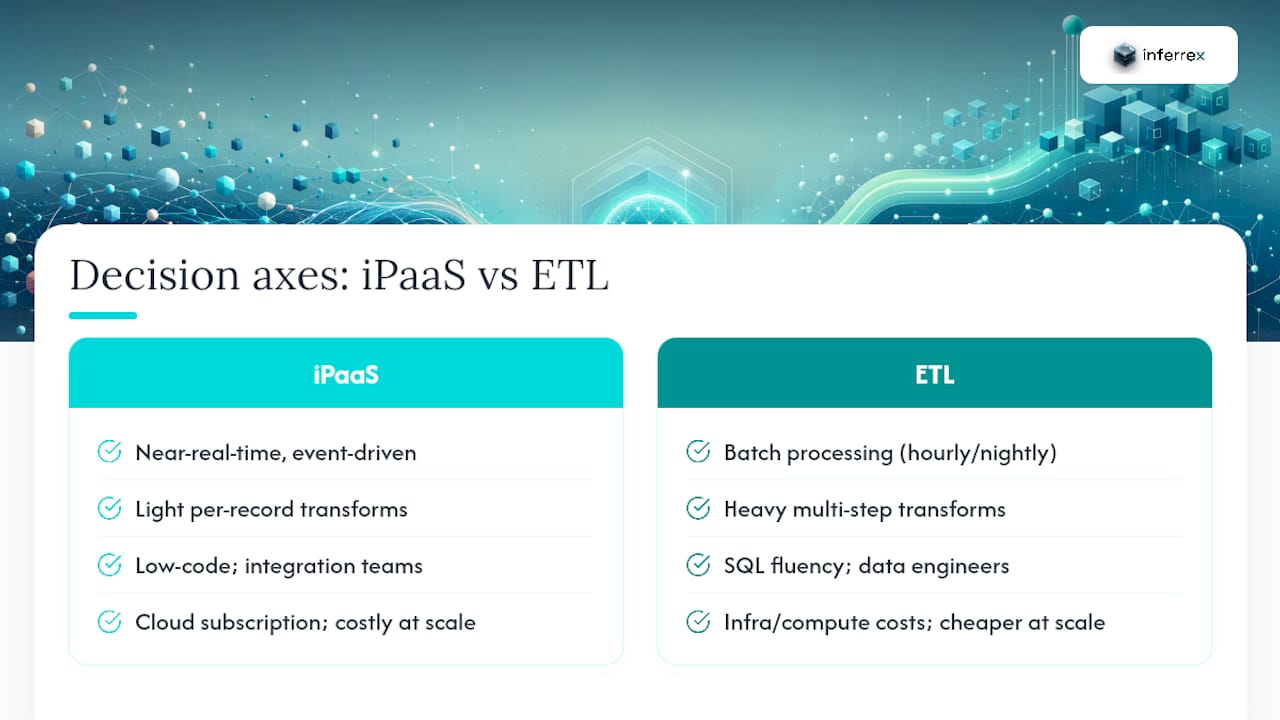
Latency and workload shape. iPaaS operates in near real time, triggered by events; ETL runs on a schedule, often nightly or hourly, processing data in bulk. If your use case cannot tolerate a delay measured in minutes, iPaaS is the only sensible starting point. If it involves millions of rows compared against historical baselines, batch processing is the more efficient design, not a compromise.
Transformation depth and volume. ETL tools are built to handle heavy, multi-step transformations across large datasets, with staging areas designed specifically to absorb that load. iPaaS connectors handle lighter, per-record transformations, field mapping, simple conditionals, format conversion, well, but they were not built to sort, aggregate, or join across terabytes.
Skills and ownership. iPaaS platforms favour low-code interfaces, which reduces dependency on specialised engineering resources for routine integration tasks. That shifts ownership towards integration or operations teams rather than data engineering. ETL pipelines typically demand SQL fluency, an understanding of dimensional modelling, and comfort with orchestration tools like Airflow or debt. Handing an ETL pipeline to a low-code team, or an iPaaS workflow to a data engineer with no context on the business process it automates, is a common source of ownership confusion.
Cost and scaling. iPaaS is usually sold as a cloud-native subscription with connector-based pricing and automatic scaling, which is convenient but can get expensive as event volume climbs. ETL, by contrast, can be more economical at very large analytical volumes, where the cost is dominated by infrastructure and compute rather than per-connector fees. The trade-off is upfront engineering effort against ongoing subscription cost, and the answer depends entirely on your volume profile.
Governance and deployment differ too. ETL tools have long supported on-premises and hybrid deployments, which matters for regulated industries with data residency requirements. iPaaS has traditionally been cloud-first and API-centric, though sovereign and air-gapped deployment options are increasingly available for organisations that cannot use a fully public cloud service.
Choosing between iPaaS, ETL, or both
Most integration decisions map cleanly onto one of a few recurring patterns, once you separate the operational question from the analytical one.
- Syncing customer or order data between live applications. This is an iPaaS job. You need low latency, and the transformation logic per record is usually thin.
- Consolidating sales, marketing, and finance data into a single reporting layer. This is ETL or ELT territory. You need heavy joins, historical comparisons, and a queryable warehouse.
- Triggering downstream actions when an event happens, a new signup, a failed payment, a support ticket. iPaaS again, because the value is in the immediacy, not the depth of transformation.
- Feeding a machine learning model with cleaned, historical training data. ETL or ELT, because model training rarely cares about the last five minutes but cares enormously about volume and consistency.
- Running both, because your operational systems need live sync while your analytics team needs nightly consolidated tables. This is the reality for most organisations past a certain size, and it is not a failure of architecture. It is the architecture.
Pro Tip: Before committing to either pattern, ask what happens if the integration fails at 3am. If the answer involves a customer noticing within minutes, you need iPaaS-grade monitoring and retry logic. If the answer is "we rerun the batch tomorrow", ETL's scheduled model is perfectly adequate.
A useful checklist before deciding: what is your tolerance for latency, in seconds, minutes, or a business day? What data volume are you actually moving, thousands of records or hundreds of millions? What governance obligations apply, and where does the transformation need to be auditable? Answer those three honestly and the pattern usually declares itself.
Where iPaaS and ETL now overlap
The clean split above is getting messier, deliberately so. Streaming ETL tools now process data continuously rather than in fixed batches, borrowing the real-time posture that used to be iPaaS's alone. At the same time, several iPaaS platforms have added scheduled batch capabilities and lightweight data warehousing features, edging into ETL's historical territory.
Modern architectures increasingly blur these lines, and the practical response is not to pick a single tool and force everything through it. It is to keep the layers conceptually distinct even as the products converge: iPaaS underneath your operational systems, handling the live plumbing between applications; ETL or ELT feeding your analytical systems, handling consolidation and historical depth.
Architects who try to stretch an ETL stack with streaming bolt-ons often hit a performance ceiling once event volume climbs, because the underlying engine was designed for batch, not continuous throughput. The more durable approach treats iPaaS and ETL as separate layers with a defined handoff, rather than one tool wearing two hats badly. Convergence in the product market does not mean convergence in your architecture diagram.
A short checklist before you sign a contract
Before evaluating vendors, or building in-house, run through a short set of questions that expose weaknesses no product page will volunteer.
- Can the platform replay a failed event or batch without manual intervention, and how far back does that replay window go?
- What does end-to-end observability look like, can you trace a single record from source to destination without stitching together three separate logs?
- How is pricing structured, per connector, per event, per GB, and what happens to that cost at 10x your current volume?
- Where does data physically reside during processing, and does that satisfy your residency or sector-specific compliance obligations?
- Does your team have the skills the platform assumes, SQL and orchestration for ETL, or workflow logic and API literacy for iPaaS?
Pro Tip: Ask any vendor to show you a failed run, not a successful one. How a platform surfaces and recovers from failure tells you more about production readiness than any demo of the happy path.
Security and data residency deserve a harder look than most procurement checklists give them. Sovereign or air-gapped deployment options exist for both ETL and iPaaS tooling now, but they are not universal, and retrofitting compliance after a platform is embedded in your operations is far costlier than requiring it upfront.
Why mapping accuracy matters more than the tool you choose
Neither pattern solves the problem underneath both of them: knowing what a field in one system actually means when it lands in another. Inferrex approaches that problem directly, using deterministic inference where relationships can be established with certainty, and AI to resolve the residual ambiguity that manual mapping tends to leave behind.
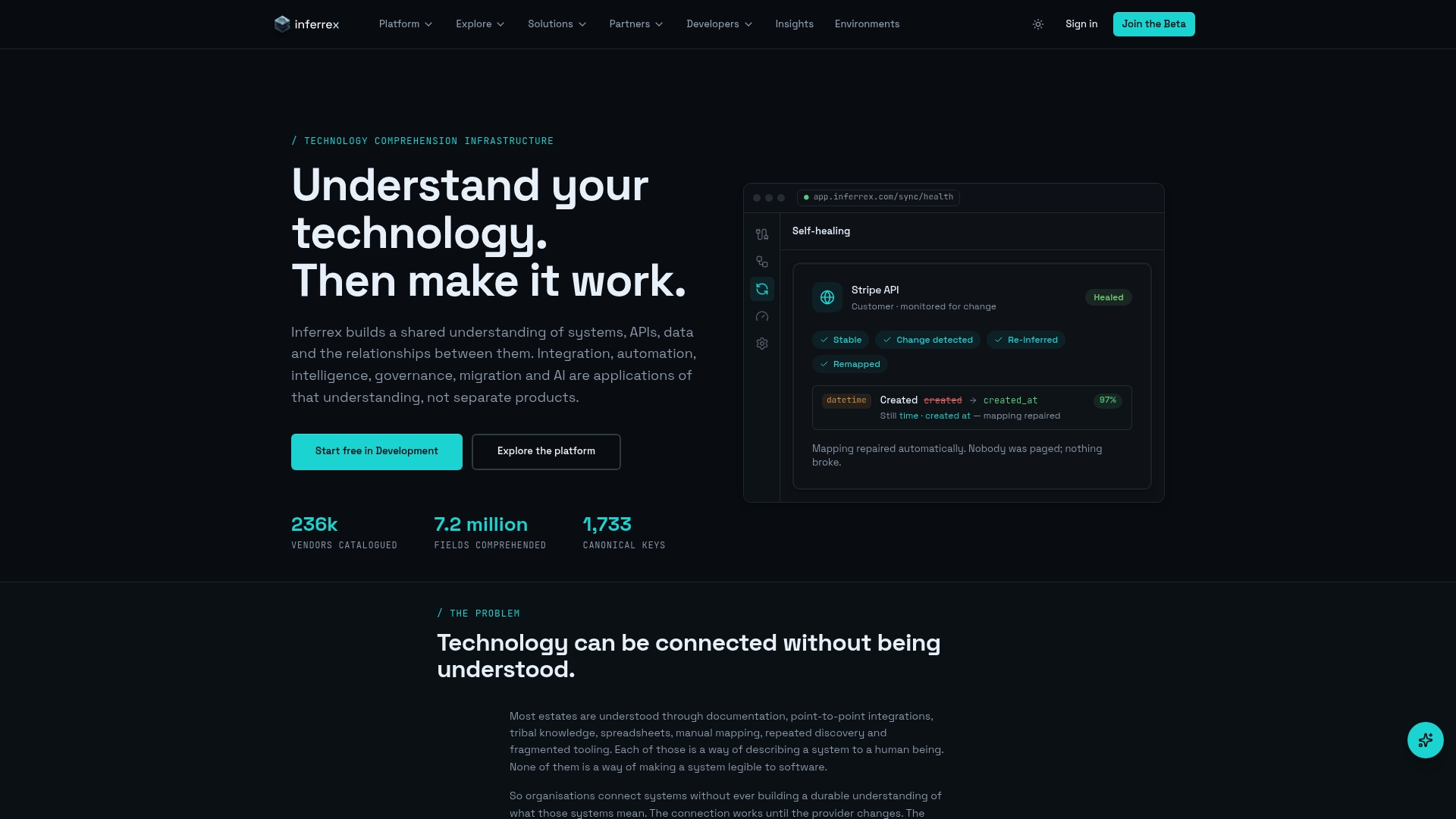
That matters regardless of whether you are running iPaaS, ETL, or both, because most integration incidents trace back to an API provider quietly changing a field that nobody documented. A live, self-healing understanding of those relationships catches that drift before it becomes a broken workflow or a corrupted warehouse table. It is a comprehension layer sitting underneath your integration architecture, not a replacement for it, and it works the same whether the data is moving in real time or on a nightly schedule. For a closer look at how the self-healing detection mechanism actually works, the technical breakdown is worth ten minutes of your time.
The one mistake that undoes both patterns
The recommendations here are not complicated, but they get ignored constantly: give each pattern clear ownership, one team accountable for operational flows, another for analytical pipelines, and resist the urge to force either tool outside its natural workload. ETL was never built for operational coordination, and iPaaS was never built to carry heavy historical analytics. Start with a small pilot on the workload you are least sure about, and measure incident rate before committing further.
— Aaron Gammon
How Inferrex reduces the mapping risk behind both patterns
Whichever pattern you run, iPaaS, ETL, or both stitched together, the recurring failure point is the same: a provider changes a field, and nobody notices until something downstream breaks. The platform is built specifically for that gap. Rather than relying on manually maintained documentation that goes stale within weeks, it keeps a live, inferred model of how systems relate, deterministically where possible, with AI resolving the remainder.
That translates directly into fewer mapping errors and faster incident response, whether the integration in question is a real-time sync between two SaaS platforms or a scheduled load into your warehouse. If you are reconciling fields across systems that were never designed to talk to each other cleanly, the Reconcile and Map capability is the practical starting point, and a free Development environment lets you see how the platform behaves against your own stack before any commercial commitment.
Sources
FAQ
Will AI replace ETL?
AI is changing how transformation logic gets written and maintained, particularly for mapping and anomaly detection, but ETL's core job, consolidating large volumes for analytics, still needs the batch architecture underneath it. Expect AI to make ETL pipelines smarter and more self-correcting rather than to eliminate the pattern.
Is AWS Glue ETL or ELT?
AWS Glue is primarily positioned as an ETL service, handling extraction and transformation before loading, though it can be configured to support ELT-style workflows depending on how the pipeline is built.
What is an example of iPaaS?
A typical iPaaS use case is syncing a new customer record from a CRM into a billing platform and a support tool simultaneously, the moment that record is created, using prebuilt connectors rather than custom code.
Is Databricks ELT or ETL?
Databricks is generally used in an ELT pattern: raw data is loaded into the platform first, then transformed using its own compute engine, which suits its role as a unified analytics and machine learning platform.
When should I use ETL instead of iPaaS?
Choose ETL when you are consolidating large historical volumes into a warehouse for reporting or machine learning, particularly where governance requires transformation logic to be centralised and auditable before data reaches shared tables.